RedefiningCommerce Payment Rails
Merchants and Users Fund the Payment System
But Bottlenecks Make the Rules
Payments are not simply "sending money" — they are "shared state change under uncertainty"
Consensus/Settlement Layer
Whoever controls the "accepted ledger update" determines what a valid payment is and can price access
Standards/Routing Layer
Without standards you get N×M integrations; the standard owner becomes a toll gate
Adjudication Layer
The entity that sets dispute rules and can trigger reversals/compensation holds structural power
Why merchants and consumers rarely reclaim that power?
Two-sided market + Network effects
Consumers want "works everywhere," merchants want "most customers have it" — this locks in the dominant scheme
Fragmentation vs Concentration
Consumers and SMBs are highly distributed, making collective bargaining hard; issuers, acquirers, and networks are relatively concentrated
Risk and credit controlled by intermediaries
The party that manages risk can charge risk premium + rule rent
Where the "rent" hides
Low marginal cost, stable take-rates
| Bottleneck Function | Who Charges | Fee Shape | Why it becomes "rent" |
|---|---|---|---|
| Issuer + Rulebook | Card scheme | bps + fixed | No connect = no global acceptance |
| Routing + Messaging | Scheme/Processors | fixed/per-tx | Marginal cost tiny at scale, but required hop |
| "Trust Badge"/Brand | Scheme | assessments | Sells coverage/trust, not measurable per-tx cost |
| Cross-border add-ons | Scheme | bps | Rule-based premium weakly tied to marginal cost |
| Tokenization/"Digital" | Scheme/Wallets | per-token/per-tx | Often directory + policy switches; low marginal cost |
| Disputes/Chargebacks | Multiple | fixed fees | Layered fees can stack regardless of actual effort |
The real question is not "can we delete intermediaries," but: Which bottlenecks can be made open and low-cost, and which must remain — yet become transparent, modular, and aligned with merchants/users?
In-Person Card Payment Fees2024 · Card-Present
Visualizing where the Merchant Service Fee (MSF) goes: Issuer / Network / Acquirer
Regional OverviewAustralia
Fee Allocation per 100 Currency Units
Total Fee: 0.65 / 100Australia: Interchange capped. High transparency (RBA Data).
Transaction Flow Diagram
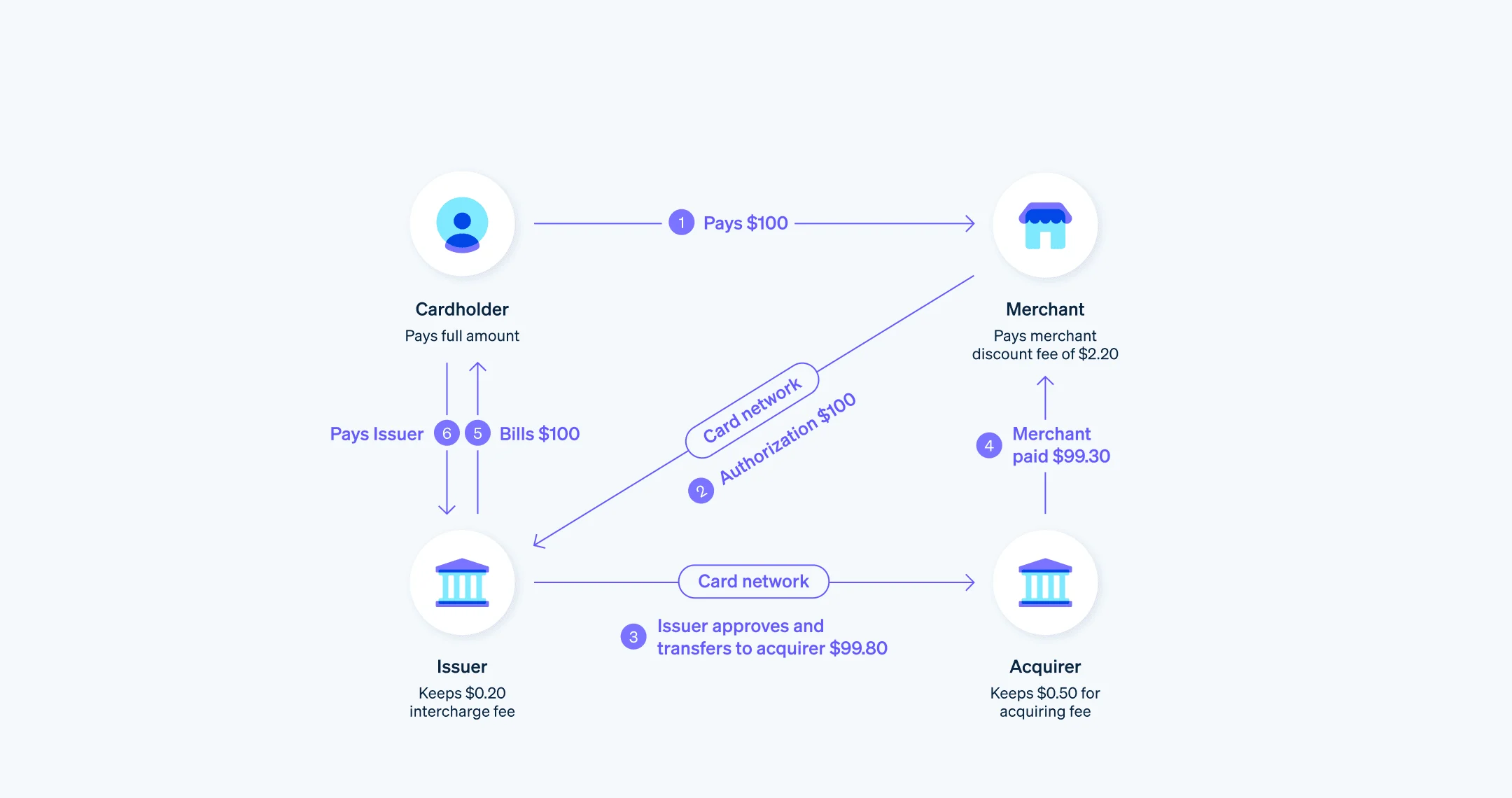
Fee Distribution Charts
OPK Comparison
OPK protocol fee is only 0.6%, which is 8% lower than the current card scheme average of 0.65%
Data Sources
Data compiled from public reports, regulatory filings, and industry estimates (2024).
Primary Sources:
- RBA Retail Payments Statistics (C3 Data)
- RBA Review of Retail Payments Regulation (Oct 2024)
- Nilson Report: Merchant Processing Fees in the U.S. 2024
- McKinsey Global Payments Report
Supplementary Sources:
- Capgemini World Payments Report 2025
- CMSPI & Worldpay Global Payments Report
- RBA Consultation Paper (Review 2025-07)
OpenPasskey + OPK
Replacing Closed Bottlenecks with an Open Scheme
Bottlenecks don't disappear — OPK repositions them from closed, rent-extractive intermediaries into open, participant-owned structures
Open Settlement
Stablecoins on an L2 as the consensus layer
Open Rules
Smart contracts + transparent parameters instead of private rulebooks
Open Participation Economics
OPK rewards + governance so contributors can own the scheme
Modular Protection Layers
Refund/escrow/arbitration options instead of one monopoly adjudicator
Why Loyalty is the Wedge
Most "crypto payments" products fail on cold start. OpenPasskey breaks that loop by starting where adoption friction is lowest and ROI is immediate.
Loyalty First
Wallet passes + NFC tap: no app, no password. Merchants get measurable retention and zero-code deployment.
Same Tap Upgrades to Payments
Once the box and wallet identity exist, payment becomes a firmware/software upgrade. Stablecoin settlement can be introduced gradually.
Then Tokenize the Scheme
OPK turns the rail into a participant-owned network where upside is shared with those who grow it.
What Blockchains Can Replace vs What Must Be Rebuilt
Using stablecoin settlement + smart contracts can directly compress or remove several rent-like layers. But some functions don't disappear — they become new modules and may form new chokepoints.
| Layer | Replaceable by on-chain? | Becomes | New Chokepoints |
|---|---|---|---|
| Interbank settlement | Largely | Stablecoin settlement on L2 | Stablecoin issuer, L2 sequencer |
| Routing / messaging | Largely | On-chain contract calls | Gas costs, sequencer ordering |
| Network rules | Largely | Smart contract params + governance | Governance capture risk |
| Merchant on-boarding | Partially | Self-serve + hardware kit | Hardware supply, local support |
| Disputes / chargebacks | Not fully | Escrow / arbitration modules | Arbitration provider power |
| Trust / brand | Not fully | Network reputation, transparent stats | Who controls "trust badge" |
| Fiat on/off-ramps | Not fully | Third-party integrations | Ramp providers, banks |
Key insight: Even fully "on-chain" systems create new chokepoints. OPK's design goal is to keep chokepoints transparent, competitive, and aligned with users/merchants.
Core Beliefs
What OPK is betting on
The next "scheme" won't issue plastic cards
It will be defined by wallet-native identifiers, passkeys, and on-chain settlement. Cards and legacy terminals become compatibility layers.
Loyalty + identity is the wedge that beats the two-sided cold start
Payments alone are a commodity; merchants switch rails only when the same rail also improves retention, discovery, and customer ownership.
Proofs of visit and spend become programmable primitives
Each tap can become a verifiable event that powers loyalty, offers, analytics, and (eventually) underwriting — over an open protocol rather than inside a closed POS.
NFC Loyalty Box
The entry point on the counter
OpenPasskey Box
NFC + QR • LTE/Wi-Fi • Android
Each participating merchant installs a small NFC device
Stand-alone Android hardware
NFC + QR, connects via LTE/Wi-Fi
Earn: tap → add/credit café pass
Staff flows ≤2 button presses
Redeem: tap → burn stamps or apply reward
No POS integration required
Future: firmware updates enable stablecoin payments
Same tap, more features
UX Layers
Three progressive layers of experience, from simple to powerful
Apple/Google Wallet cards branded to each merchant. Show stamp progress and simple offers. Activated by QR or NFC.
Web views at stable URLs: customer, staff, admin. Used for dashboards, history, campaign setup, support.
Network-wide view: stablecoins, Café Tokens, OPK balance. Surface for advanced actions (cross-merchant swaps, staking, governance).
Participants
Key roles in the network
Consumers
Tap to earn/redeem, optionally pay with stablecoins, earn OPK
Merchants (cafés/SMBs)
Pay SaaS (AUD $30/device/month), install boxes, issue Café Tokens, optionally accept stablecoins, earn OPK
Third-party value providers
Brands/apps/service providers pay to access OPK users (offers, trials, bundles), earn OPK when their campaigns help grow the network
Market makers / LPs
Provide liquidity for OPK–stablecoin and CaféToken–OPK pools, earn fees + OPK
Builders / developers
Build wallets, analytics, discovery and marketing tools on OPK rails, earn OPK based on usage
Investors & core contributors
Provide capital and work to bootstrap the protocol and hardware
Three-Layer Token Design
OPK uses three token layers, each serving a distinct purpose
Stablecoins
Money Rail
- Fiat-pegged ERC-20 stablecoins (e.g. AUD, USDC)
- Used as the payment medium for "real-world" transactions
- Protocol fee target: 0.6% at scale
Café Tokens
Local Loyalty Liability
- Per-merchant units representing local reward promises
- Issued when a visit is rewarded; burned when redeemed
- Can be off-chain, on-chain ERC-20/1155, or hybrid
- Not intended as transferable global money
OPK
Universal Reward & Network Stake
- Single fungible token with two functions
- Universal reward ("Amex points")
- Network stake (governance + value capture)
OPK Deep Dive
Single token, two functions
Universal Reward
OPK is earned by participants when they perform network-accretive actions
Network Stake
OPK is staked to participate in governance, a portion of protocol revenue routes via Treasury into OPK buybacks and reward programs
Supply and Allocation
Total supply: 1,000,000,000 OPK (fixed cap)
Rewards for consumers, merchants, value providers, LPs, builders
Seed and later rounds
Long-term incentives
Initial liquidity, reserves
Over time, most OPK is expected to end up with network contributors, not only with founders and early investors.
Value Extraction vs Value Capture
Card rails don't just charge fees — they centralize rule-making and then monetize those rules through mandatory take-rates and add-ons
Revenue Sources
SaaS Fees
AUD $30/device/month
Point Swap Fee
2% on cross-merchant swaps
Stablecoin Payment Fee
0.6% of transaction value
Value Slot Revenue
Third parties pay to show offers
Treasury Split
Indicative percentages adjustable by governance within bounds
OPK buybacks and distribution
Product, hardware, sales, support
AMM seeding, MM incentives, co-marketing
Reserves and contingencies
$100 Transaction Comparison
Traditional card rail vs OPK rail
Traditional Card Rail
Value Extraction Model
Customer Pays
$100
Merchant Receives
$98.70
OPK Rail
Value Capture Model
Customer Pays
$100
Protocol fee
0.6%
Merchant Receives
$99.40
+ OPK Rewards
"Value Reactor" Model
OPK is designed so that value flows into the token, rather than leaking to external intermediaries
Protocol fees as value sink
0.6% fee goes to Treasury, accumulating cash backing, funding OPK buybacks and rewards
External flows inject value
Traders/LPs, advertisers, long-term investors' funds flow to OPK pool, not external platforms
Intrinsic vs Market Value
Intrinsic value (EPS) + Market value (multiple of expected future fee flows) = Multiplier effect
Illustrative Example (for intuition only)
Merchant processes $100:
- Receives$99.40
- Earns this epoch500 OPK
Assumptions (illustrative only):
- Intrinsic backing$0.0001/OPK
- Market price (32× PE)$0.0032/OPK
- 500 OPK market value$1.60
* This is not a guarantee of any specific return. It illustrates the design goal: lower base fees vs legacy rails, and reroute upside to network participants.
OPK Ecosystem Simulator
Value Capture vs Value Extraction — Real-time comparison of traditional payment rails vs OPK ecosystem
OPK Ecosystem Simulator
Value Capture vs Value Extraction
Traditional Payment Rail
OPK Ecosystem
Phased Rollout
Phasing is indicative and may change based on progress
Pilot
Prove the counter UX
- NFC box hardware design finalized
- First café pilot in Melbourne
- Wallet pass integration (Apple/Google)
- Basic earn/redeem flows tested
Loyalty SaaS
Own the identity + distribution
- SaaS product launch
- Merchant onboarding portal
- Café Token issuance
- Analytics dashboard
- 50+ merchant target
Stablecoin Payments
Test behavior change
- Stablecoin payment integration
- Merchant settlement in AUDC/USDC
- Consumer funding options
- Refund/escrow module design
OPK Launch
Contribution Mining
- OPK token genesis
- Contribution mining live
- Treasury contracts deployed
- Initial liquidity pools
Scheme Mechanics
Decentralization
- Open API/SDK for builders
- Governance parameters tunable
- Multiple arbitration providers
- Geographic expansion
Known Risks
This design is a starting point, not a guarantee of success. The following is a non-exhaustive list of risks.
Adoption Risk
HighMerchants may not adopt or may churn; consumers may not change habits
Execution Risk
HighHardware supply, software reliability, and UX must meet real-world standards
Market Risk
HighToken demand and price may be volatile; OPK may not trade at any implied "intrinsic" value model
Consumer Protection Risk
MediumStablecoin payments can be irreversible at the base layer; without well-designed policies, UX can regress
Regulatory/Compliance Risk
MediumPayments, loyalty, stablecoins, and tokens may be regulated differently across jurisdictions
"Bottlenecks Move" Risk
MediumEven if card networks are bypassed, new chokepoints emerge: wallet/OS distribution, stablecoin issuers, L2 sequencers, on/off-ramps
Liquidity Risk
MediumCross-merchant swap UX depends on healthy liquidity; thin pools can create slippage and poor user outcomes
Governance Risk
LowToken governance can be captured or mis-configured; must be constrained by safety bounds and upgrade discipline
Competitive Risk
MediumLarge incumbents could respond with similar wallet-native loyalty offerings or crypto-enabled rails
Disclaimer
This document describes a proposed technical and economic design for the OpenPasskey protocol and OPK token. It is not legal, tax, financial, or investment advice and does not constitute an offer to sell or a solicitation of an offer to buy any token or security in any jurisdiction. All mechanisms, parameters, and timelines described are illustrative and subject to change based on technical progress, regulatory requirements, and community input.